
Choosing the Right Calgary Neighbourhood: What Buyers Should Consider

When people begin searching for a home, it is easy to focus almost entirely on the property itself. The layout, kitchen, garage, backyard, square footage and finishes often take center stage.
But over time, many homeowners realize the neighbourhood itself can have an even greater impact on day-to-day life than the home itself.
A beautiful property in the wrong location can still feel like the wrong fit.
The most popular neighbourhood is not automatically the right neighbourhood for every buyer. A neighbourhood that works extremely well for one household may create daily frustration for another.
Every community comes with strengths, tradeoffs, limitations and long-term considerations.
The goal usually should not be finding a forever-perfect area. The goal is often finding a community that best supports your current lifestyle, priorities and likely next chapter of life.
Realistically, many Canadians move more often than they initially expect due to career changes, growing families, downsizing, lifestyle shifts, health needs or financial considerations.
Analysis of Statistics Canada mobility data suggests many working-age Canadians relocate approximately every 5.5 to 7 years on average.
That makes it important to think strategically about how a neighbourhood fits not only today's needs, but also how life may evolve over time.
This article is not intended to create debate around redevelopment, transit expansion, rezoning or urban growth policies.
Calgary continues to evolve, and different buyers will naturally have different priorities and perspectives.
The goal here is simply to encourage thoughtful consideration of how neighbourhood characteristics and future change may align with an individual buyer's lifestyle, comfort level and long-term goals.
1. Lifestyle Compatibility & Stage Of Life
One of the biggest mistakes buyers can make is choosing a neighbourhood based primarily on the property itself without fully considering how they actually live day to day.
Some people thrive in highly walkable communities with restaurants, activity, coffee shops and constant movement nearby.
Others strongly prefer quieter residential streets, larger lots and a more private atmosphere.
A neighbourhood that works extremely well at one stage of life may also feel far less practical at another.
Young professionals may prioritize proximity to downtown, restaurants and nightlife.
Families may focus more heavily on schools, parks and recreation.
Downsizers may prioritize accessibility, healthcare access and reduced maintenance responsibilities.
Some buyers also need to think longer term:
- Will you eventually want easier access to medical services?
- Could aging parents eventually move in?
- Will teenagers eventually need transit access or walkability?
- How important is privacy versus convenience?
- How much driving are you realistically comfortable with long term?
Lifestyle compatibility can dramatically affect long-term satisfaction with a home purchase.
2. Infrastructure, Schools & Daily Convenience
Some Calgary communities are fully mature and self-contained.
Others are still developing and may take years before all planned amenities arrive.
This can significantly affect daily life.
Important considerations may include:
- Grocery store access
- Medical clinics and pharmacies
- Restaurants and retail
- Recreation facilities
- Public and Catholic school availability
- Specialized programs
- School overcrowding
- Transit infrastructure
- Road connectivity
- Emergency services access
Some newer communities market future schools, shopping centers and transit plans that may still be years away from completion.
Meanwhile, many established neighbourhoods already have mature infrastructure in place.
Many buyers underestimate how valuable simple day-to-day convenience becomes over long periods of ownership.
3. Parks, Greenspace & Community Character
Every Calgary neighbourhood has a different feel.
Some communities feature:
- Mature trees
- Larger lots
- Architectural variety
- Established landscaping
- Unique streetscapes
- Ravines and natural areas
- Pathway systems
- Mountain views
- River access
- Lake amenities
Others offer:
- Modern layouts
- Newer infrastructure
- Higher energy efficiency
- Contemporary architecture
- Lower-maintenance living
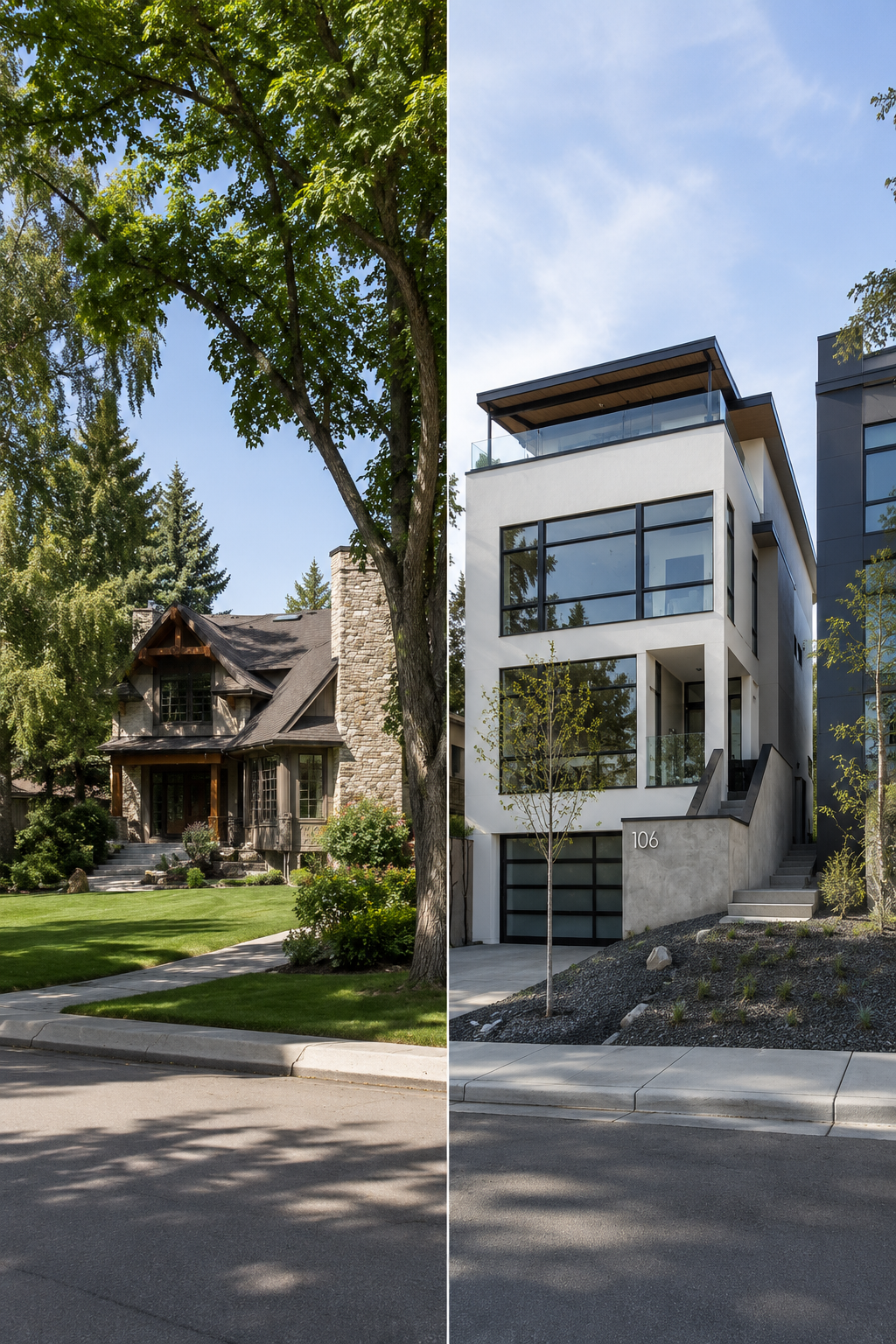
The era in which a community was developed can also significantly influence its overall character and functionality.
Older Calgary neighbourhoods may offer larger lots, mature trees and more established streetscapes, while newer communities may prioritize higher density, modern planning concepts, pathway integration and mixed-use development.
Street layouts, garage placement, lot widths, architectural styles and even parking availability are often heavily influenced by the planning philosophies of the time in which a neighbourhood was built.
The mix of housing within a community can also influence neighbourhood feel, traffic levels, parking availability and long-term flexibility for residents.
4. Risk, Exposure & Long-Term Resiliency
Every neighbourhood comes with different forms of exposure, risk and long-term considerations.
These are not always obvious during an initial home search.
Examples can include:
- Floodplain or overland water considerations near rivers
- Hail exposure and insurance realities
- Wind exposure in certain areas
- Drainage concerns
- Winter driving challenges on steep terrain
- Aging infrastructure in mature communities
- Ridge lots with potential erosion or slope-related considerations
- Stormwater management limitations
- Access during severe weather events
In Calgary specifically, severe hail events have become an increasingly important ownership consideration in some areas due to insurance deductibles, roofing materials and long-term insurability concerns.
Likewise, homes near rivers, ravines or ridge lines can offer incredible lifestyle benefits and views while also carrying unique environmental or maintenance considerations.
None of these factors automatically make a neighbourhood "bad."
They simply represent variables buyers may wish to evaluate more carefully before purchasing.

5. Future Development, Transit Expansion & Neighbourhood Evolution
Calgary continues to evolve, and very few neighbourhoods remain completely unchanged over long periods of time.
Future growth can bring meaningful benefits to some communities, including:
- Improved transit access
- Additional amenities
- Increased walkability
- Revitalization
- New housing opportunities
At the same time, growth and infrastructure changes can also alter the character and day-to-day experience of a neighbourhood over time.
Depending on the project and location, some buyers may wish to consider potential impacts such as:
- Increased traffic
- Parking pressure
- Higher density
- Construction disruption
- Changing streetscapes
- Increased public activity
- Noise
- Evolving commercial corridors
Transit expansion is one example where buyer perspectives can vary significantly.
Some homeowners strongly value improved connectivity and long-term infrastructure investment, while others may prefer quieter, lower-activity environments further removed from major transit corridors.
Redevelopment can also influence neighbourhood dynamics over time.
In some cases, revitalization and reinvestment may support long-term desirability and property values. In other situations, rapid change, heavy construction activity or uncertainty around future development patterns may create concerns for some buyers.
While Calgary's current blanket rezoning framework is being repealed, it is widely expected that future policies supporting additional density and housing growth will continue to emerge in various forms over time.
City planning initiatives such as Local Area Plans can also provide insight into how certain communities, corridors and transit areas may evolve in the years ahead, including potential changes related to density, mixed-use development, transit connectivity and long-term growth priorities.
Some buyers intentionally seek evolving communities with increasing amenities, revitalization and long-term growth potential.
Others may place greater value on stability, predictability and lower-intensity change over time.
No neighbourhood is completely static, and buyers should think not only about what a community looks like today, but also what it could realistically feel like 10 to 20 years from now.
6. Think About Whether The Community Can Grow With You
While many people move more often than they initially expect, some buyers still hope to remain within the same broader area or community for many different stages of life.
That is where neighbourhood flexibility can become important.
Some communities offer a wider variety of housing types and lifestyle options over time, including:
- Condominiums
- Townhomes
- Starter detached homes
- Larger family properties
- Luxury homes
- Adult living options
- Lower-maintenance downsizing opportunities
This can allow homeowners to potentially remain connected to the same schools, amenities, social networks, healthcare providers, recreation opportunities or general area familiarity even as their housing needs evolve.
Other communities may offer a much narrower range of housing options, which can sometimes make long-term transitions more difficult without leaving the area entirely.
For some buyers, choosing the right neighbourhood is not necessarily about finding one home to last forever.
It may instead be about finding a community that can continue supporting different chapters of life over time.
Questions Worth Asking Yourself Before Choosing A Neighbourhood
- How important is walkability to me?
- Do I prefer mature trees or newer infrastructure?
- Am I comfortable with future redevelopment nearby?
- How important is transit access?
- Do I value quiet streets or convenience more?
- How much driving am I realistically willing to do?
- Is this likely a shorter-term or longer-term home?
- How important is outdoor access?
- Could my lifestyle change significantly over the next 5–10 years?
- Am I prioritizing emotional excitement or long-term compatibility?
Final Thoughts
Choosing the right neighbourhood is rarely about finding perfection.
More often, it is about understanding tradeoffs, priorities, lifestyle compatibility and how a community may support your life both now and in the years ahead.
The most popular neighbourhood is not automatically the right fit for every buyer, and a community that works extremely well for one household may create daily frustration for another.
Some buyers may prioritize quiet streets, larger lots and long-term stability. Others may value walkability, transit access, evolving amenities or proximity to work and entertainment.
Some may prefer mature communities with established infrastructure and character, while others may be drawn to newer areas offering modern layouts, pathway systems and future growth potential.
The goal is not necessarily finding a "perfect" neighbourhood, but rather finding one that aligns well with your lifestyle, priorities and long-term comfort level.
Calgary offers an enormous variety of community types, each with different strengths, limitations and future considerations.
Buyers who take the time to think beyond the excitement of a single showing and evaluate factors such as infrastructure, redevelopment, resiliency, convenience and long-term neighbourhood evolution are often better positioned to make confident and informed decisions over time.

Disclaimer: The information provided in this article is intended for general educational purposes only and should not be considered legal, financial, insurance, engineering, planning or investment advice. Community characteristics, school boundaries, transit plans, development policies, infrastructure projects, insurance requirements and municipal planning initiatives can change over time. Buyers should conduct their own due diligence and consult appropriate professionals when evaluating a property, neighbourhood or community. Information is believed to be accurate at the time of publication but cannot be guaranteed.
Categories
Recent Posts